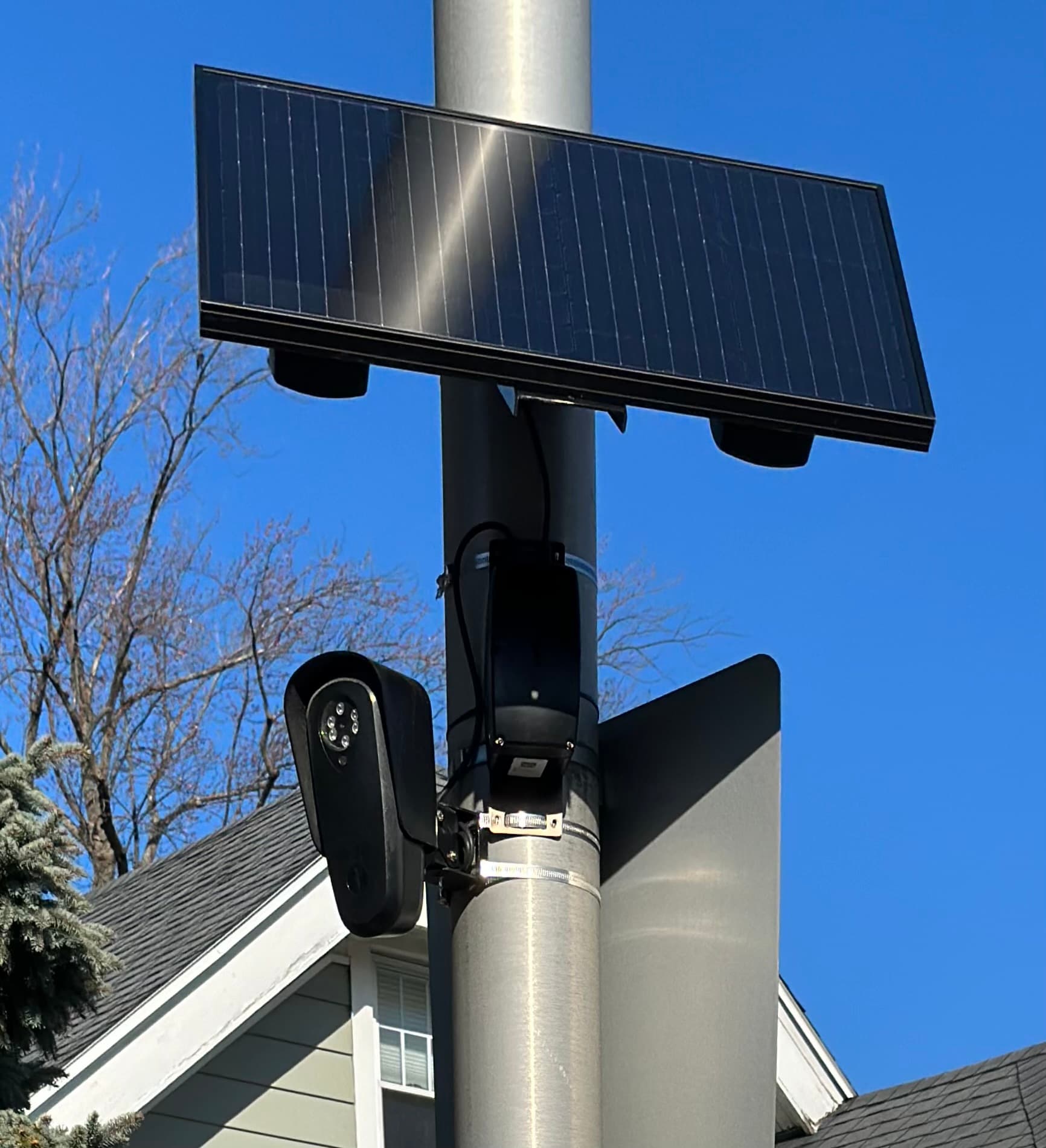
Common visual features
A typical installation may include a small camera housing aimed across a traffic lane, a slim or segmented support arm, a pole placed near the road shoulder, and a solar panel mounted above or beside the unit. Because the camera needs a clear view of vehicles, its angle often looks lower and more directly aligned with the lane than a broad overview camera.
These are clues, not a checklist. Power options, pole styles, enclosures, mounting height, antenna arrangements, and camera generations can differ. A damaged or upgraded installation may have parts that no longer match an older photograph. Other ALPR manufacturers also sell compact units, and general traffic sensors can use similar poles and solar panels.
Where Flock cameras may be installed
ALPR cameras are often positioned where vehicles pass through a predictable field of view: road entrances, intersections, neighborhood access roads, parking approaches, or routes selected by the operating organization. Public and private deployments can look alike from the roadside. The pole's location does not by itself identify the operator, the legal authority for a search, or whether data is shared with another organization.
Never enter a roadway, private property, utility area, or restricted site to inspect equipment. A zoomed public photograph, government agenda packet, procurement record, or agency transparency page is safer and generally stronger evidence than a close physical inspection.
How it differs from other roadside cameras
| Visible clue | Possible interpretation | Why it is not proof |
|---|---|---|
| Compact head aimed at traffic | Could be an ALPR unit | Traffic sensors and security cameras can use a similar angle |
| Separate solar panel | Suggests a self-powered roadside device | Many wireless monitoring devices use solar power |
| Intersection mast-arm camera | Often traffic monitoring or enforcement | Mounting conventions vary by jurisdiction |
| Manufacturer label | Strong direct evidence when legible and current | Confirm the label belongs to the active camera, not another component |
How to confirm the manufacturer
Start with evidence that can be checked by someone else. Useful sources include a clearly readable product label, a city council packet, a signed procurement contract, an agency camera-location page, a public presentation naming the equipment, or a cited OpenStreetMap manufacturer tag. Record the source and date because hardware and contracts can change.
This project does not infer Flock from color, shape, operator, nearby cameras, or a familiar-looking solar panel. If the public evidence establishes that a device is an ALPR but not who made it, the correct label is Manufacturer Unknown. Learn more in our classification methodology and the plain-language ALPR overview.
Check a public map record
The interactive Flock camera map lets you open a point, view its public OpenStreetMap source, and see the classification evidence used by this project. A missing or unknown point should not be treated as proof of absence.
Frequently asked questions
Are all Flock cameras solar powered?
No. A solar panel is common in publicly visible examples, but power and installation details can vary.
Can I identify a Flock camera by its shape?
Not reliably. Shape is only a clue because other roadside devices and ALPR manufacturers can look similar.
Does a camera near a neighborhood entrance belong to the police?
Not necessarily. Public agencies and private organizations can operate or fund roadside systems. Confirm the operator through reliable records.
How does this site decide that a point is Flock?
It requires approved OpenStreetMap manufacturer evidence. Otherwise a supported ALPR record remains Other ALPR or Manufacturer Unknown.